Sunday, 16 August 2020

photos of 2020 gardening


2020 Gardening photos

 This is our garden photos. It is the unified effort of man and the nature. Sun, moon, earth, air, water, birds, bees, bacteria, fungus, earthworm etc  all played a vital role in producing the results.  Our garden is partially based on permaculture.

"Permaculture" or permanent  agriculture is a way of farming in which we create an eco-system with plants, bees, animals, birds, insects, micro-organisms and other elements of nature. When they come together it creates a highly productive food forest. It is a system that works with  nature and not against it. While focusing on agriculture it also establishes  the importance of  integration between landscape and people. Permaculture don't require large machinery, high energy, more water, more chemical fertilizer and insecticides, to become an efficient food producer. 

A permaculture garden is a happy and peaceful place. It is pure and spiritual. It is fruitful, nutritious and non toxic. It is an oxygen factory. Gardening is not wastage of the natural resources, but producing maximum with less effort, less time,and least natural resources. 

This is Peony in our garden
We urbanites have taken so much from the nature , done more harm to nature than countryside residents. It is our turn to give back to nature. Our food is without nutrition. Our water is polluted, and air is unclean. In order to save the planet, our survival and the next generation let us start today at least in small way. It is our turn today.

Here in our garden we created a combination of  permaculture and natural farming. Fukuoka, a Japanese natural farming enthusiast initiated natural farming. Look at the forest. Is there anyone to take care of millions of big trees and diversified eco system?. They are not just growing but they are thriving. Fukuoka shown that by taking care of the soil, we can reduce or go without the chemical fertilizer, herbicides, insecticides  and do farming.

Vegetables we grow
Beans: scarlet runner, Romano, Borlotti, heirloom.
Tomatoes: Cherry, Black, yellow lemon, Beef, Early girl.
Leaves: (Cruciferous: Kale, collard green,) Swiss chard, Radicchioo,Arugula.
Pumpkin: Kabocha, Japanese orange, blue habbard, zucchini, cucumber.
Tuber: carrot, beats, potatoes.
Allium family: Onion, chives and garlic, leeks.

                                                       Dhalia
Fruit trees we grow
We got Apples, Figs, plums,Pear, blueberries and grapes with  different varieties with different ripening time. Raspberry, Thornless blackberry  are also  adding to the beauty of the garden.  

What do we do with the produce? A  normal question most people ask. We store this most valuable organic food for the winter months. We share with friends, neighbors,  who don't have the opportunity to grow and relatives around the world. "We never tasted a fruit like what you have given" is a common remark from our friends. That remark keep us rolling the wheel of gardening. Some of the produce we share happily with birds,and  bees.etc.

 Gardening gives us non toxic, organic, fresh, tasty and nutritious  food. Some of the vegetbles and fruits we grow  are not available in the market beacuse they require tender care and have less shelf life. What we grow is picked when it is fully riped. Oh what a taste it is!. Gardening gives us physical, mental and spiritual enrichment. It makes us closer to nature . God created the garden first and then Adam and Eve to take care. We are all created to be gardeneners. A gardenener goes to each and every plant sense their needs mainly when they  hungry or thirsty and  feed them accordingly.When the plants are stressed he realises it and pacifies it. This is what God intended of us ie help the needy. Gardening is a stress free, calm and peaceful  life filled with health and happiness.If we can do it you too can .Come on enjoy gardening.We can help you.
Fruit Trees we grow in detail
Apple- Spartan, Liberty, Akane, Honey Crisp, Chahalis,Golden delicious, Whitney crab,  Gravenstein, Astra, Ambrosia etc
Plum: Pluot (gold plum), shiro( Japanese), Italian prune, Italian regular,Yellow plum, Green gage, Royal. 
Fig: Lattarula, Desert King, Chaicago Hardy, Viloet De bordeaux, Olympian
Grapes: Himrod, vitis vinefera, Niagra, Concord seedless, Grape de chunac.
Blueberry: Reka,Summer breeze, duke, bluecrop.
We got assorted trees with different  ripening time and disease resistance.

Pluot- plum +apricot hybrid ( gold plum) 
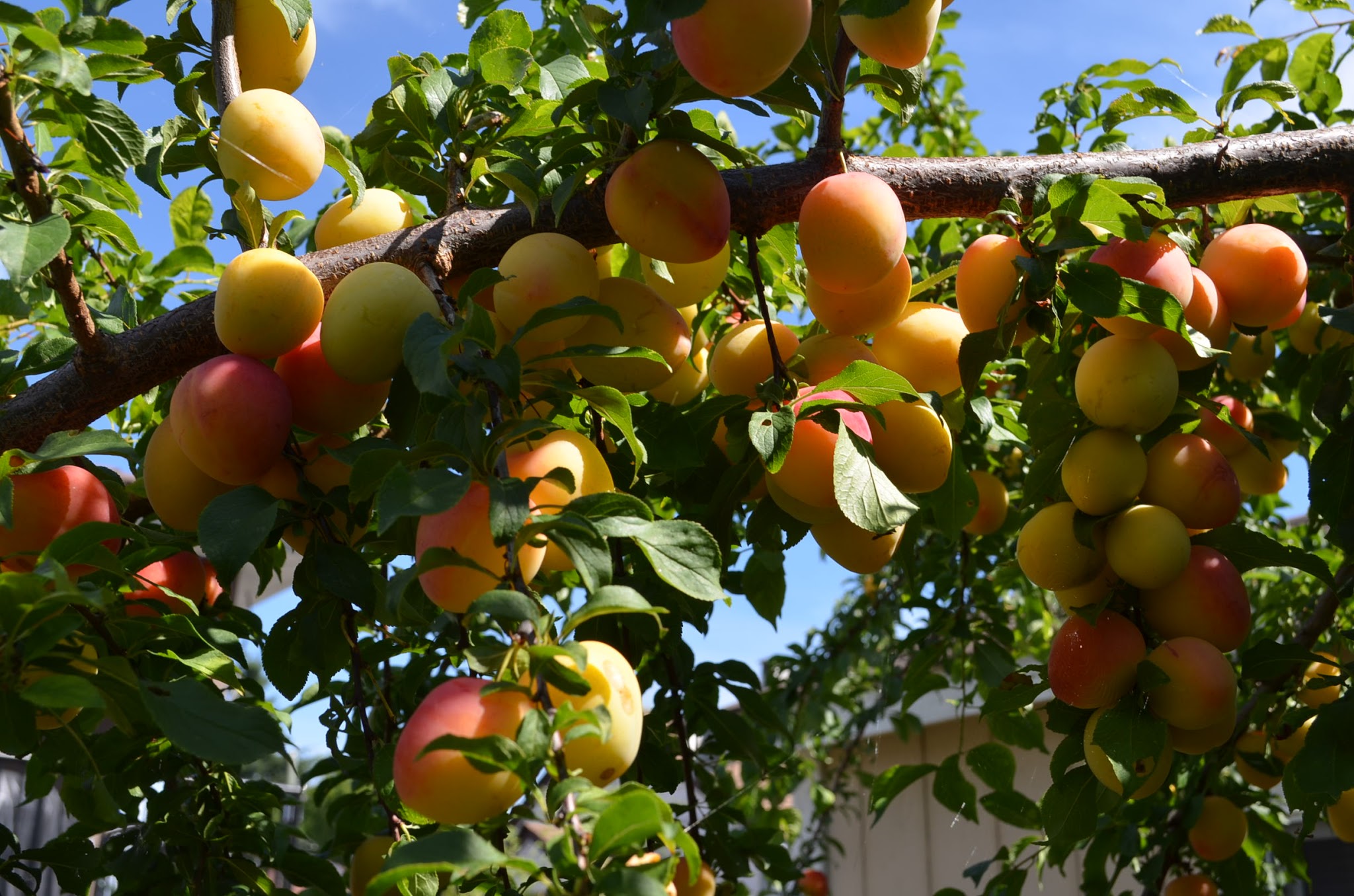
This gold plum is usually not avialabe in the market.

Tomatoes

Apple First  year after grafting - around 20 apples but 
since it is small tree about 70% is removed early.


Latarulla- Italian Honey fig


Hot chilly- locally acclimatised European chilly " Tomy Hot"


Beans 

Kale- There is no day without  kale leaf  in salad
Swiss chard .Tastier than red cheera- easy to grow in North America and Europe
The heirloom Roma beans- to go freezer before blanching.
Russian Red garlic. Easy to grow


Another baby apple tree in pot with fruits it can't bear


Italian prune plum
 Whitney Crab apple, golden delicious  all in container 
Vitis Vinefera grapes
Thornless blackberry
Chicago hardy fig
Italian prune plum
Shiro- Japanese plum
Desert king Fig
Shiro plum
Blanched ready to store in freezer for the rest of the year
Ready to blanch


Blue habbard- one of the tastiest pumpkin variety
another apple baby tree 2nd year in 2 gallon bucket


Roma soup beans 

Heirloom Roma poll beans
A bunch of vitis vinefera grape


A type of rose grapes

 Apples from many places lives together in containers
All in continer
In container
In container


Our old friend apple planted on the ground- Mc intosh


Peony flower


Our best friend  Mason bee's nest. They live only 4 months.Pollinate 4 months ,lay eggs and die. The eggs remain in the fridge for another 6 months before the cocoon grows in to a bee.


The following are from my friends prize winners. 

Single onion weighs 1.8 kg- produced by Garry, Sanich, Victoria.BC
The pumpkin around 15 to 20KG It is pleasure to see them- Fleming


Saturday, 11 March 2017

How to plant a tomato

How to plant a tomato

planting from the pot Add calcium, bone meal and compost
Fill the side minimum 1" below ground level


water full after planting.


How to plant a fruit tree


How to plant a fruit tree .


How to plant a fruit tree on ground.

Planting a fruit tree is very important. A fruit tree has to survive for more than 30 years in cold winter and harsh summer. For that the root system has to be healthy. The organic matter in the pit is often ignored. Organic matter serves as a reservoir of nutrients, air and water,  reduces compaction and surface crusting . It increases water infiltration  into soil. It reduces clogging and increase drainage.

Diameter 18 inch depth 18inch
Make a pit  about 18 inch diameter, 18 inch depth. Fill the bottom six inch with organic matter like dried leaves, peat moss, compost   mixed with ¼ dirt.  Sprinkle 10 table spoon of bone meal inside the pit where the root will touch the soil for building healthy root system.

A pit for planting

Then place the pot plant one inch below the ground level and fill the side or gap  with:  1)compost, 2) peat moss or dried leaves or organic matter  3) dirt or soil at 1: 2: 1: ratio. If you got potting soil that can be used instead of the above. Make sure there is no air gap on the side or bottom. 
If it is grafted tree make sure the  graft is above ground
Make a raised  border around the tree to keep the water and manure 


Best time to plant a fruit tree is  2nd half of March, April and first half of May. That is the stage when trees are awakening after the dormant winter and spring towards summer season. This is based on Vancouver climate.


Please watch the first video. That will give you a better picture.
 2nd video is also helpful.

https://www.youtube.com/watch?v=dSIxzkaDOTA


Saturday, 8 October 2016

Garlic- Easy to grow in Canada and America


Garlic


Why do you grow garlic in Canada and America.


It grows easily well in Canada and America. The imported garlic is grown with chemicals banned in certain countries. The imported garlic is picked much before it gets here and sprayed with methyl bromide ( a toxic substance)  which stops sprouting. When you buy these imported garlic you are doing " buy one get one free" you get frequent illness too.
Read this:
http://www.lambsearsandhoney.com/2010/06/australian-garlic-vs-imported-garlic-whats-the-difference/

Garlic varieties are divided into two:  hard neck and soft neck. Hard neck has large cloves and cold tolerant, and delicious. Smaller soft neck cloves grow well in warmer climates is common in super markets and stores for a long period.


Highly rated varieties for BC coastal gardens are: purple softneck, Musica, Red Russian, Italian Porcelain.

Planting.

Use a hoe to form 3 inch deep furrows spaced 8 inch apart. Space cloves  5 inches apart, and cover with 2 inches soil on top. 
Growing


Plant garlic 2 to 4 weeks before the frost  in  fall to harvest in summer. When planted before frost, the roots will go deep and the plant will remain dormant and will start growing in spring, when weather improves.  It is better to plant in the middle of September or third week of September or beginning of October in BC,Canada.  After planting cover bed with 4 inch layer of loose straw mulch to prevent from frost and weed. However do not mulch in climates with wet, mild winters. As soon as you notice new growth pull the mulch away from the plants in to spaces between furrows.

Garlic in pots
Plant garlic 1 to 2 inch deep 4 inch apart in good potting soil.
Growing tips.

Avoid too much watering after the flower bulb is formed. The deep roots will collect water. Clear any humus that can create fungus especially close to the bulb. If the bulb is planted too deep that may cause fungus on the bulb.

Fertilizer
While planting add composted well rotten manure and phosphorous (bone meal) Add one table spoon NPK in the soil.  Mix well into the soil.
Early spring apply high nitrogen fertilizer , balanced NPK every month until scapes are formed. 
Cut scapes. Stop watering after scapes are formed. 

Harvesting
Garlic leaves taste similar to garlic chives. You can cut one or two leaves off the plant as soon as they become 8 inch tall with a sharp knife.


Cut the scapes ( flower)  when they emerge from the  from the topmost  leaves just as they begin  to curl. Removing scapes encourages the bulbs to grow bigger.
When half the leaves have yellowed use garden fork and loosen the soil pull it out.

Storing
After harvesting mature bulbs tie six plants together and hang them in warm, dry, shady spot for 3 to 4 weeks until the papery wrappers are very dry. Use  tooth brush to remove excess soil and trim the roots. Keep the bulbs in cool, dry , non frost spot for around six months to one year. Keep them  in net nylon bags in open cartons. Garage without heating may be a better spot. 

You can easily grow them in your backyard or pots. The shoots in spring  look so beautiful when there is no much greenery around. Moreover you will get organic pesticide free and chemical free garlic too.


Read this  to know how good is  imported garlic we get in super markets.Ref: http://www.lambsearsandhoney.com/2010/06/australian-garlic-vs-imported-garlic-whats-the-difference/

useful video
https://www.youtube.com/watch?v=yA034iOkenQ

Saturday, 9 April 2016

How to start a vegetable garden


How to start a Kitchen  garden?


Have you ever considered growing your own vegetable garden? Perhaps you may not know how to grow one, you may think there is no time, you may think there is no space to plant. The reasons may be too long. But look at the expression of vegetable garden owners. “ there is an intense flavor in my home grown vegetables” “They are fresh and delicious” “No pesticides”” Organic” “Self-reliant” “satisfaction of eating your own produce is immense” “I love peace and solitude in my garden” “Look at the miracle of a tiny seed growing to big plant” “It revitalize the energy, be with nature, what a privilege!”  “Bye-bye to frequent illness, and avoid diabetes, and cancer” "I am happier and healthier now"  Do you want to be happy and healthy   as these gardeners?
Michelle Obama.
She learned first   how to garden and then started  teaching
gardening to students in White house garden


You don’t require rocket science to become a good gardener. A little thirst for knowledge, patience, and love of nature will make you master gardener.


Start  small


One of the common errors beginners do is planting too much too soon without knowing  how, when and what to grow. It is better to be a proud small gardener than a frustrated big one.  So start small.

Tips to start


1.   Location. Select a sunny location. Vegetables require 6 hours of direct sunlight per day.  The more the sunlight they receive, the greater they grow well.
2.   Soil. Plant in good soil. Read the detailed portion.


3.   Space your crops properly. Plant  them in  in required distance. Follow and planting space guide on seed packets. Plants too close  may  not grow well due to lack of sunlight, water  air and nutrition.


4.   Use good quality seeds


Swiss Chard
The life of any garden is in the soil. Rich soil consists of humus or organic matter which will provide pockets or “pore space” for air and water.


 When new homes are built or during construction the rich organic top soil is removed by machine and bottom soil from the hard pan are exposed. The first step is to remove the hardpan soil and add 2 ft of top soil or add some organic matter on top.

Take care of soil, soil will take care of the plant.


The most important resource in any garden is the soil, in which the plants grow.  Any soil may support plant, but good soil increase the health, strength and beauty of the plant. Fertile soil is well-drained, aerated and rich in organic matter rich in micro-organisms and bacteria. It should help water retention, nutrient retention; provide plant food, support   and thermal insulation.  Digging will improve drainage, and adding organic matter will improve the soil texture and beneficial bacteria.


There are different soil types. 


There are sandy, clay, loam, peat and silty soil

Type of soil
Problems
How  to improve
Clay
Very slow to drain water, heavy and difficult to work. Surface cracks in dry weather
Improve drainage, Dig and add organic matter, add lime,
Sandy
Light and very free. Drains very fast and nutrients are drained fast.
Add organic matter  and fertilizer
Loam
None
Add organic matter  and fertilizer if/ as required
Peat
Very acidic, slow to drain. Lacks nutrients. Add lime  as required to control PH
Improve drainage. Add lime
Silty
Soil is slow to drain, heavy and difficult to work like clay. Surface cracks in dry weather
Dig to add organic matter. Fertilize as required.


 The soil pH

Kale
The degree of acidity and alkalinity (the pH) of the soil determines the nutrients absorption by the plant. The soil acidity and alkalinity are measured on a scale of pH ranging from 0 to 14. A pH below indicates acid soil and above 7 is alkaline. A pH of 7 is neutral. Most plants grow in between 5.5 and 7.5 pH.
How to improve the soil


Humus or organic matters are essential to improve soil and sustain plant growth.  It is the life of the soil By adding organic matter regularly will improve drainage, fertility, and increase water retention of the soil. The decomposing of the organic matters will improve bacteria and microorganism of the soil.   To keep the soil fertility apply organic matters regularly like  composts, dry leaves, wood mulch, and coir pit, leaf cuttings, grass clippings  etc. to soil.  Producing your own compost from household waste will give you manure as well as solve the problem of waste.  To maintain the same level of fertility, it should be remembered, “Whatever comes out of soil should go back to the soil”. Or else it will lead to depletion.

 Garden  Tools.

1) Garden hand fork
GARDEN TOOLS
2) Trowel


3) Garden fork
4) gloves
5) Homi digger ( A very good Korean garden tool)
6 ) Pruning scissors
7) Water can


Plants.   

Decide what you want to grow. Categorize your requirements.


1.   Herbs- Mint, Parsley, celery, coriander, oregano, rosemary


2.   Leaves- Kale, Swiss chard, cabbage, broccoli, lettuce, spinach


3.   Roots- Potatoes, beet root, carrot, radishes.


4.   Beans- bush beans, pole beans, broad beans.


5.   Onions, garlic, shallots, chives


6.   Tomatoes- Cherry tomato, Roma, medium, big. 


7.   Squash and pumpkin, zucchini,cucumber


8.   Others: Chilly, capsicum, red spinach, bitter gourd


9.   Fruit trees. Plum, apple, blueberry, strawberry, grapes, raspberry.
 
Designing a vegetable bed

Making a raised veg garden.

Raised bed structure
Raised bed veg garden solves   a lot of problems.  It warms up even quicker in winter, reduce weeds and stops roots from other trees . It keeps well drained soil rich of oxygen for the roots.

Don’t make your bed more than 4 feet wide.  You can easily reach the garden from outside without stepping inside the wee drained soil.
How to make a raised bed? See the video

https://www.youtube.com/watch?v=B--i7Cv8ffA

 Container garden. Please see separate chapter.

Watering plants

Watering is crucial to the plants for their growth, health and prevention of disease. Air temperature, soil type, cloud cover, wind, natural precipitation, and plant maturity all determines the amount of water and how often you will need to water.

It is better to water in the morning before day warms up. If watering in the evening the water or humidity remains on the foliage and if temperature drops down below 12 Deg C it will damage the leaves, and promotes fungus and other diseases.

Saturate the roots
Water the soil. Soak fully the roots not the leaves. Soaking will promote the roots to go deeper and save the plant from draught. Over watering may result in draining the nitrogen from the soil.
Insulate soil with mulch or organic matter like straw, hay etc. to hold the moisture and prevent weeds.

Foliar feeding

It is better to be done in the morning.


You can do wonders. Gardening improves your happiness, health and wealth as well as your family and community. Your contribution can change the world. Wish you happy gardening.

For further Reading. See        karshakan school
https://www.facebook.com/groups/603613809690378/

Click "Discussions" to see the videos.


Frozen home grown fruits ( grapes and gold plum)
for winter smoothies and juice